Stockity Trading Guide 2026: How Fixed-Time Trading Works for Beginners

Stockity offers direction-based, fixed-time trading in which users predict whether an asset’s quoted price will be higher or lower at expiry. This guide explains the trading interface, payout calculations, demo mode and the risk of losing the full amount placed in a trade.

Fixed-Time Trading on Stockity: A Beginner’s Guide
Never traded on Stockity before and not sure where to begin? This guide covers everything from the basics of binary options to executing your very first trade on the platform — broken down into simple, clear steps anyone can follow.
Understanding Binary Options Trading
Getting familiar with how binary options work before touching the platform makes the entire experience significantly smoother and less overwhelming.
This product is often described as binary-style trading, because the outcome is based on a yes/no price direction call at expiry. Rather than purchasing and holding an asset like a traditional investor would, binary options traders make a single directional prediction — will the price of a chosen asset be higher or lower at a specific point in time?
If your prediction turns out to be correct when the trade closes, you receive a fixed return on the amount you invested. If your prediction is incorrect, you lose that invested amount. Two possible outcomes, one decision — that is the entire basis of binary options trading.
What makes Stockity particularly appealing for new traders is how it simplifies this process:
- An intuitive and uncluttered interface that does not overwhelm first-time users
- Expiry times starting from just 60 seconds up to several hours
- Clearly displayed fixed payouts before every trade so you always know what you stand to earn
- A completely free $10,000 demo account for risk-free practice
- 30 professional analytical tools built directly into the platform
Assets Available for Trading on Stockity
Stockity provides access to a range of financial instruments spanning multiple market categories. Asset categories and availability can change — use the asset selector inside the platform as the current, authoritative source rather than any fixed list.
| Asset Category | Examples |
|---|---|
| Currency Pairs (Forex) | EUR/USD, GBP/USD, USD/JPY |
| Commodities | Gold, Silver, Oil, Coffee, Corn |
| Indices | Various index instruments |
| ETFs | Various exchange-traded funds |
| OTC Assets | Available outside standard market hours |
Trading an instrument on Stockity does not necessarily mean purchasing or owning the underlying stock, cryptocurrency, commodity, or ETF. You are trading on a price-direction outcome, not acquiring the asset itself.
Every asset carries its own behavior, volatility level, and available trading hours. Major currency pairs may have more active market pricing during standard sessions, but they remain volatile and do not provide predictable outcomes — high liquidity does not make a trade easier to win.
Should You Start on Demo or Real Account?
Stockity gives every registered user access to two separate trading environments:
Demo Account
- Pre-loaded with $10,000 in virtual trading funds
- Demo mode is designed to resemble the live trading interface, although available assets, payout rates, account conditions, and even trading behavior may differ from real-money trading
- Demo losses do not affect real funds, but demo results do not predict real-account performance
- Resets whenever your balance needs topping up
- No deposit required to access it at any time
Real Account
- Activated with a minimum deposit of just $10
- Eligible real-account balances may be withdrawn subject to account verification, payment rules and applicable terms.
- Access to deposit bonuses and active platform promotions
- Entry into trading tournaments with real cash prize pools
- Eligibility for the referral program rewarding up to $100 per successful invite
The smart approach: Resist the temptation to deposit immediately. Spend genuine time on the demo account until you feel truly comfortable with how the platform operates and how trades behave. Rushing into live trading before you are ready is one of the most common and costly mistakes new traders make.
Essential Trading Terminology
Getting comfortable with these terms before your first trade will make the entire process feel far more natural:
Strike Price
The market price of your chosen asset at the exact moment your trade is opened. Your prediction is evaluated against this price when the trade expires.
Expiry Time
The length of time your trade remains active before the result is determined. Available durations are shown in the trading interface and may vary by asset, product mode, and account conditions.
Payout Percentage
The profit percentage returned to you when a trade closes in your favor. For example, an 84% payout on a $10 trade means a $10 stake returned plus $8.40 in profit if the trade wins — a total of $18.40 — or the loss of the $10 stake if it doesn’t.
With an 84% net payout, the theoretical break-even win rate works out to roughly 54.35%, before accounting for any other conditions.
UP Trade
A prediction that the asset price will finish higher at expiry than it was when you opened the position.
DOWN Trade
A prediction that the asset price will finish lower at expiry than it was when you opened the position.
Trade Amount
The sum of money you commit to a single trade. This represents your maximum possible loss if the trade closes against your prediction.
OTC Assets
OTC instruments may be available outside standard market hours. Their quotes can behave differently from exchange-traded market prices, and weekend or off-hours OTC pricing does not necessarily represent the underlying market.
Check what methodology or source Stockity discloses for these quotes, if any, before trading them.
Placing Your First Trade on Stockity — Full Step-by-Step Walkthrough
Step 1 — Sign In and Open the Trading Environment
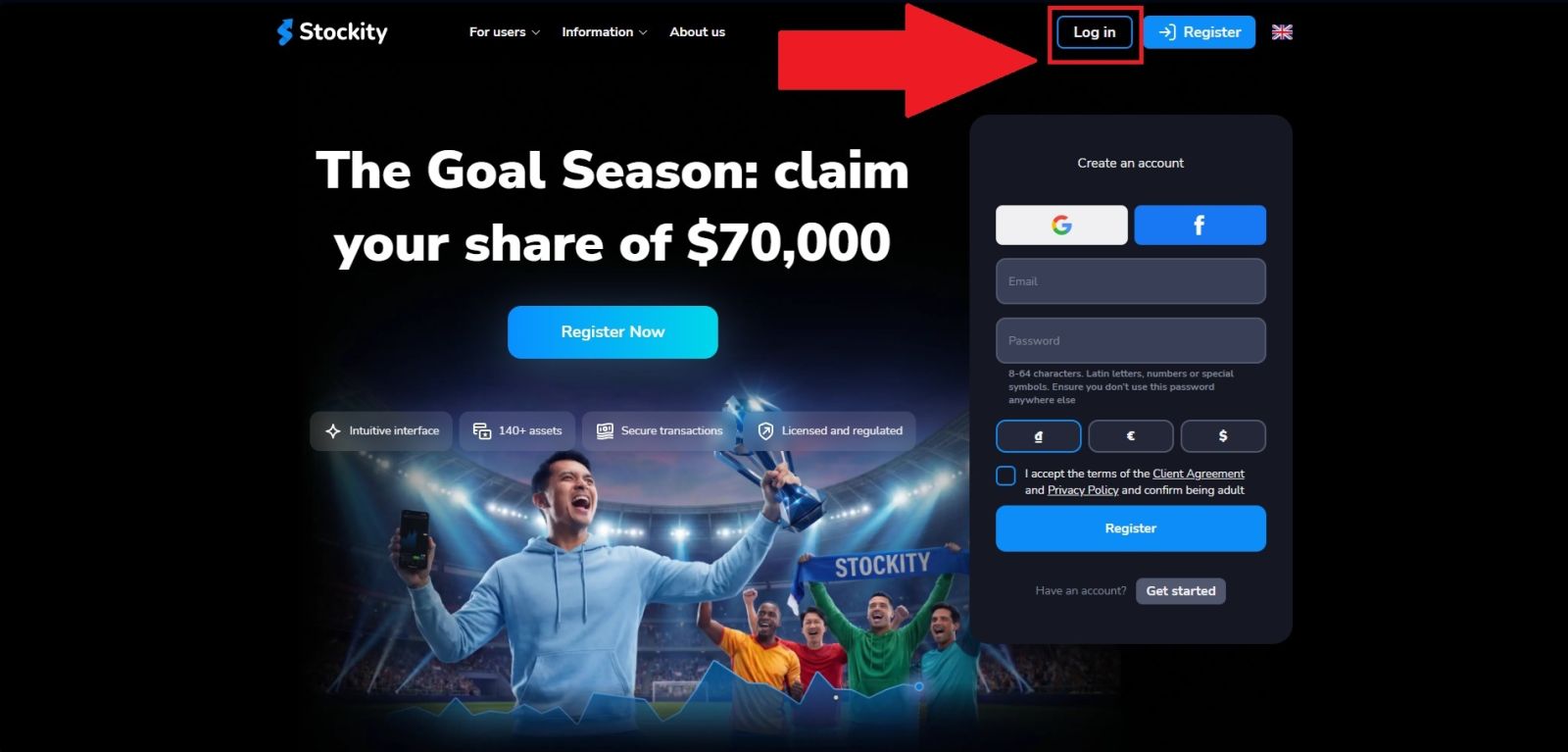
Launch your browser and head to the official Stockity website. Click "Log in," enter your registered email and password, and complete any two-factor authentication prompt if applicable.
Step 2 — Enter the Live Trading Screen
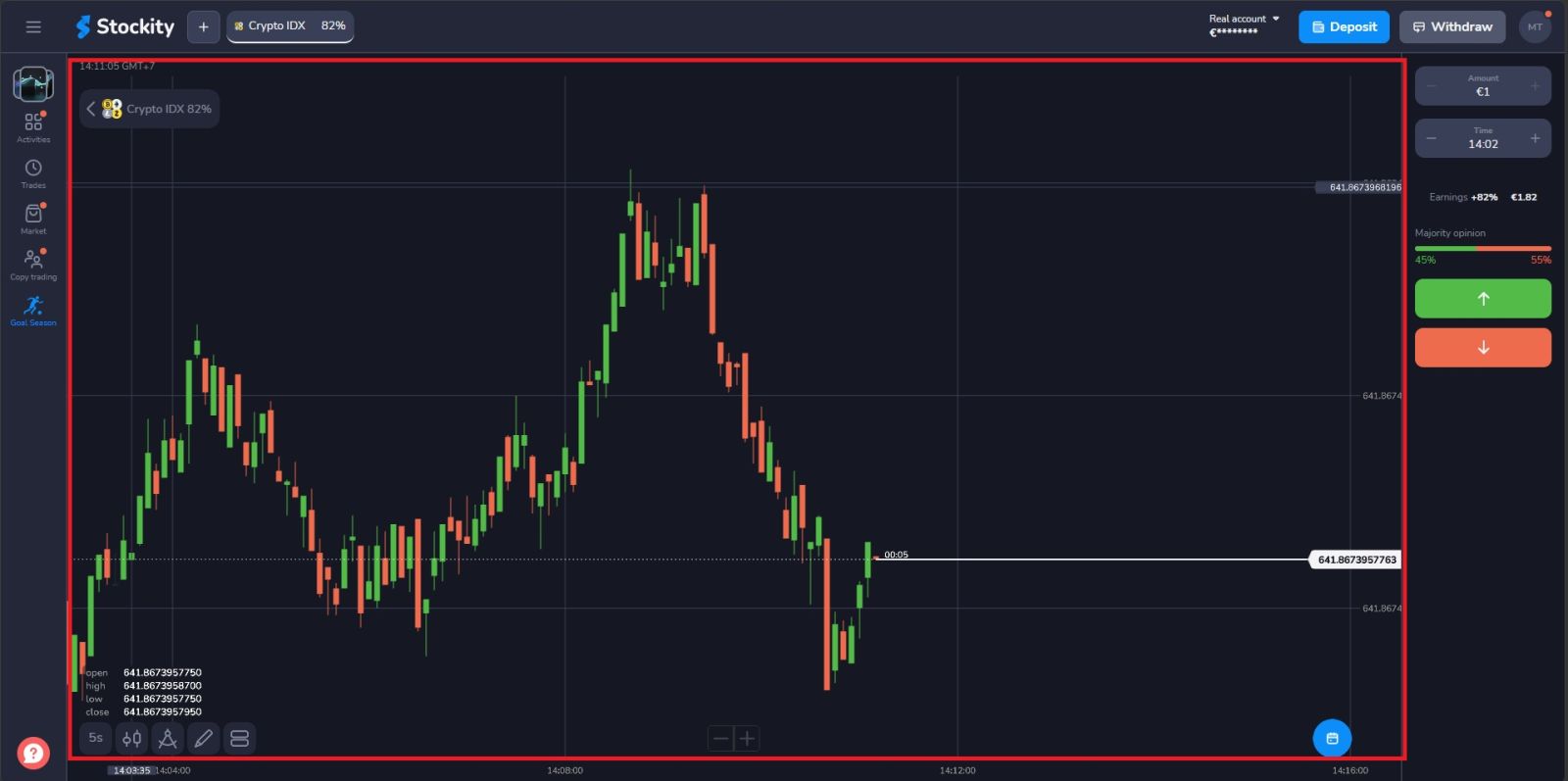
Once inside your dashboard, you will land directly on the homepage — this is your starting point for everything trading-related on Stockity.
If you are not yet ready to commit real funds, switch your account to Demo Mode by toggling between demo and real account at the top of the screen. This gives you full access to the trading environment using virtual funds, allowing you to practice and build confidence without any financial risk.
Step 3 — Pick Your Trading Asset
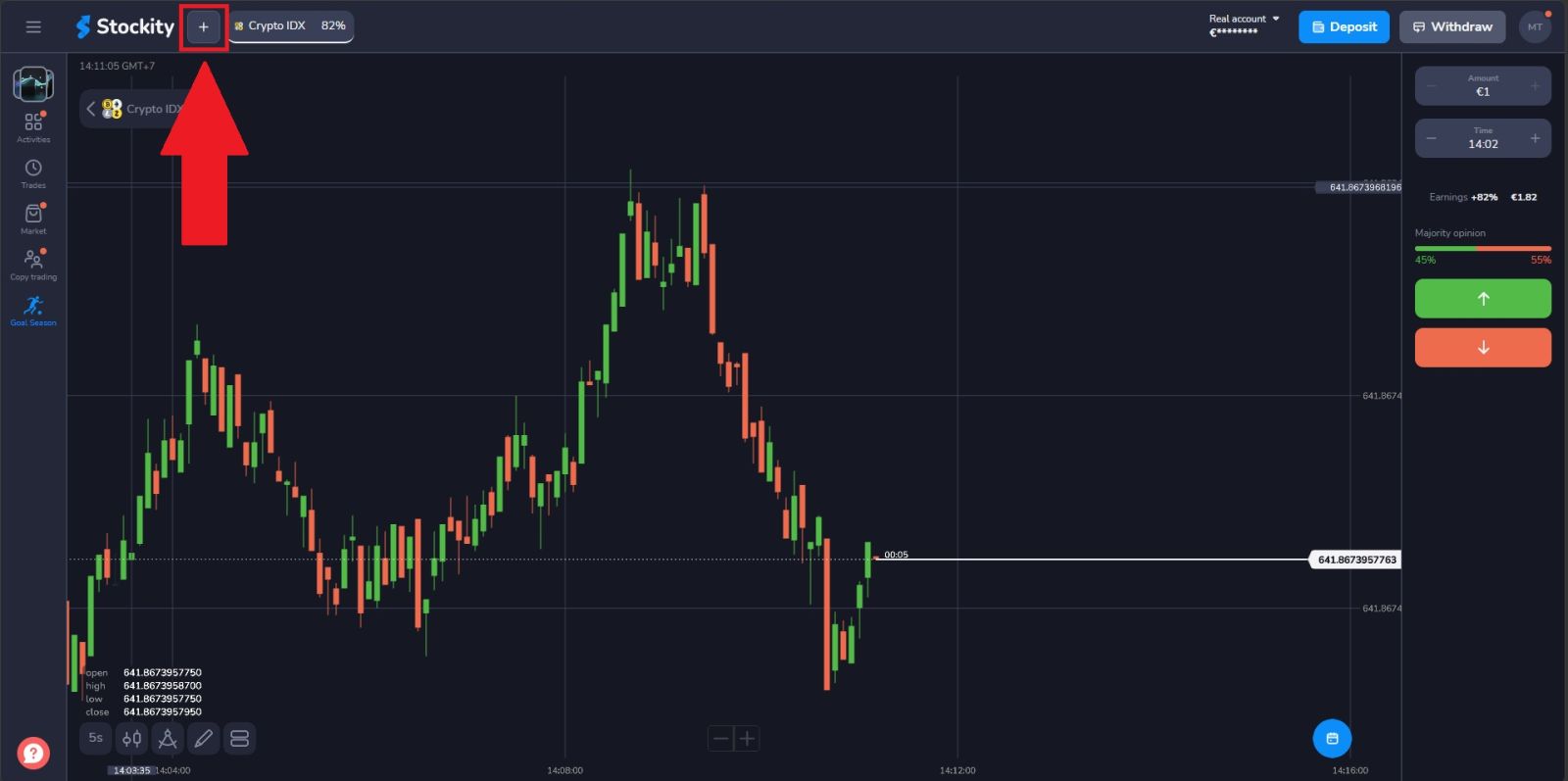
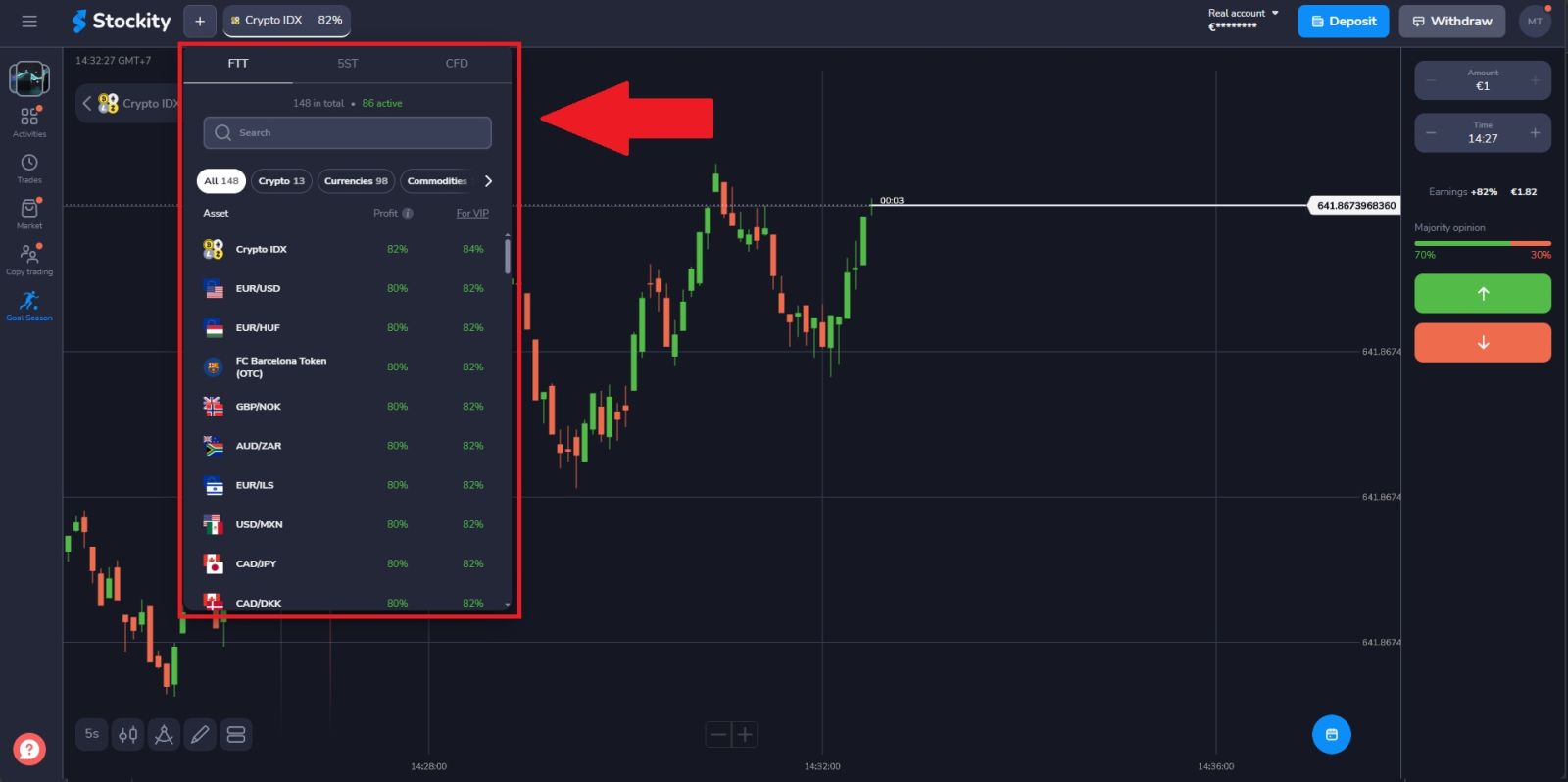
Click the "+" icon at the top of the screen to open the asset selection panel. Inside you’ll find available instruments organized by category, such as Indices, Commodities, Currencies, and ETFs — the exact categories shown depend on what’s currently available on the platform.
Each listed asset shows:
- The name and identifying icon of the instrument.
- The current payout percentage available on that asset.
- A condensed price chart giving a quick snapshot of recent movement.
Step 4 — Study the Chart Before Committing
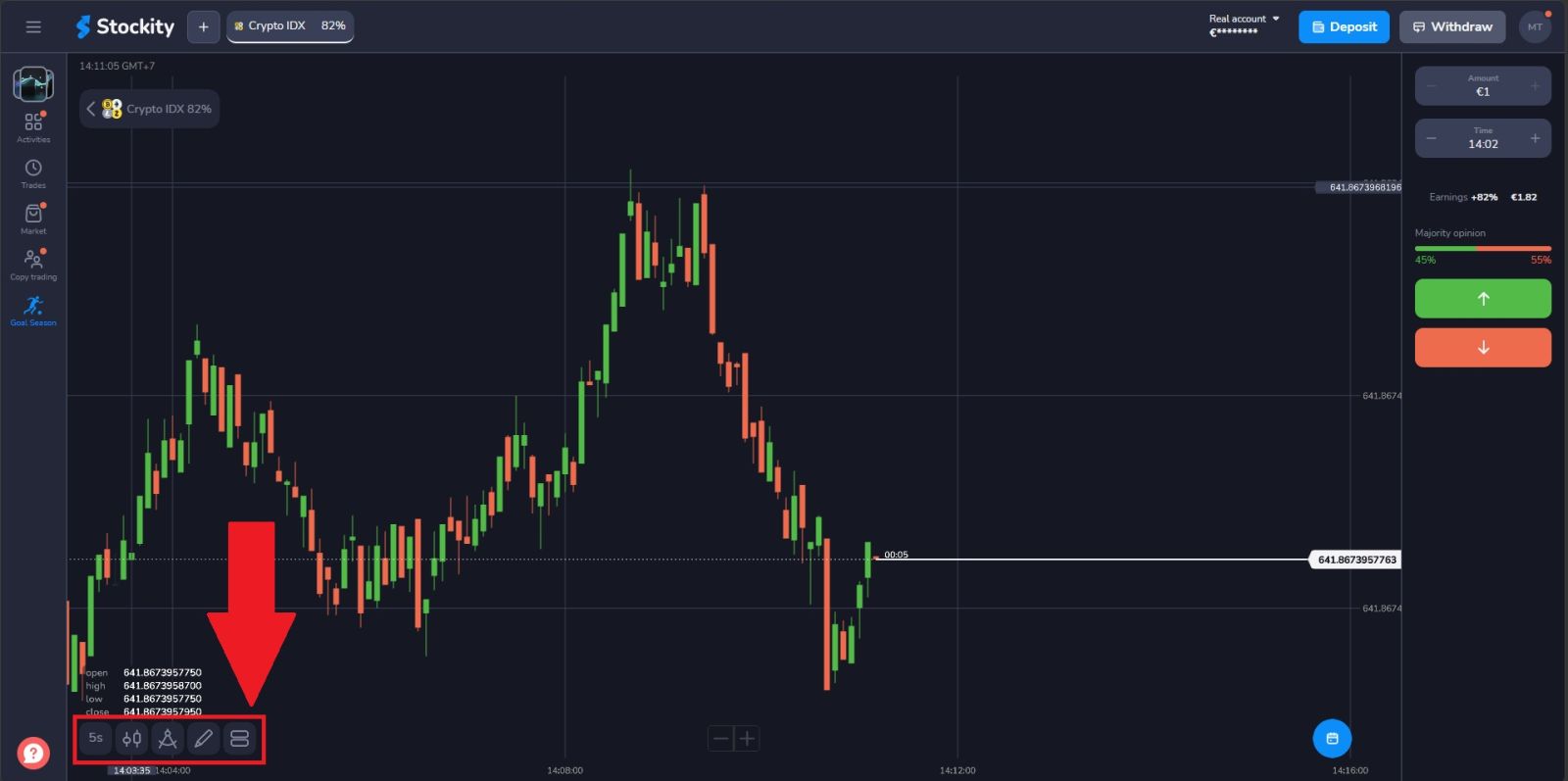
Never open a trade without first analyzing what the chart is telling you. Stockity equips every trader with 30 professional tools accessible directly from the chart toolbar — here is how to make the most of them:
Switch to Candlestick View
Candlestick charts provide a richer picture of price behavior than standard line charts. Each individual candle reveals the opening price, closing price, and the highest and lowest points reached during that time period — invaluable information for making informed trading decisions.
Step 5 — Execute Your Trade
1. Investment Amount
Enter how much of your balance you want to commit to this trade. Using a small, consistent amount relative to your balance — rather than a large one — helps protect your account from being wiped out by a losing streak.
2. Expiry Time
Decide how long you want the trade to run before the outcome is settled, from the durations shown in the interface. Very short expiries move fast and are highly unpredictable; longer expiries give price movements more room to develop.
Two buttons sit at the bottom of the trade panel:
- 🟢 UP — select this if your analysis suggests the price will be higher when the trade expires
- 🔴 DOWN — select this if your analysis suggests the price will be lower when the trade expires
Click the button that reflects your prediction. The trade opens immediately at the current market price, and a live countdown timer begins tracking the time remaining until expiry.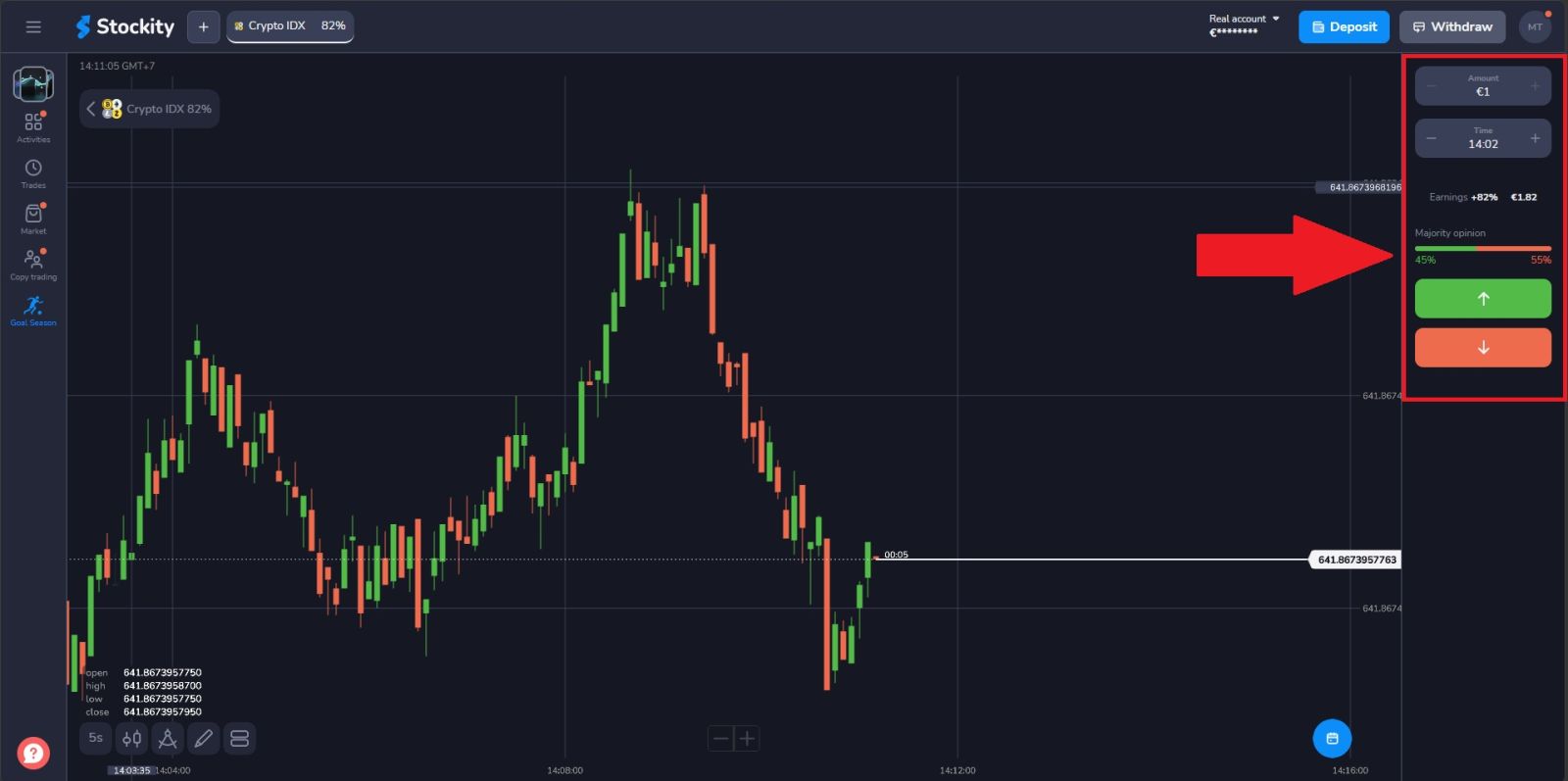
Three Common Analysis Approaches Beginners May Encounter
These are educational concepts, not proven profit systems. No indicator or approach can reliably predict short-term market movements, and any of them can still result in a loss.
1. Following the Trend
Identify the dominant direction of price movement using the chart and a moving average indicator. If prices have been climbing consistently, some traders open an UP trade aligned with that momentum; if prices have been falling, a DOWN trade. Trading with the trend rather than against it is a common approach, though it is not a guarantee of a favorable outcome.
2. Trading Support and Resistance Zones
Mark price levels on your chart where the market has historically bounced upward from (support) or reversed downward from (resistance). Price sometimes reacts similarly when it revisits these zones, though this pattern does not always repeat. Use Stockity’s drawing tools to mark these levels on your chart.
3. Using OTC Assets for Flexible Trading Hours
If your schedule means you’re most active during evenings or weekends when major markets are closed, Stockity’s OTC asset selection may offer trading opportunities during those hours. Keep in mind that OTC pricing can differ from the underlying exchange-traded market — see the OTC note above before relying on it.
Mistakes That Cost New Stockity Traders Money
Placing Trades Without a Reason
Every trade should be backed by a clear observation from your chart analysis. Trading on instinct or impulse consistently produces unpredictable results over time.
Betting Too Large on Individual Trades
Concentrating a large portion of your balance on a single trade is a fast path to an empty account. Use a small amount relative to your account balance, set a personal loss limit, and avoid increasing your stake after a loss.
Attempting to Recover Losses Immediately
The impulse to place a larger trade straight after a loss in order to win it back is called revenge trading. It almost always compounds the problem rather than solving it. Accept losses calmly and move forward with discipline.
Bypassing the Demo Account Entirely
Depositing real money before practicing on demo is an expensive shortcut. Demo mode helps users learn the interface with virtual funds, but demo results do not guarantee similar outcomes with real money.
Placing Too Many Trades in One Session
Placing trade after trade without sufficient analysis leads to impulsive decisions and emotional fatigue. A structured process may reduce impulsive decisions, but it does not eliminate losses — being selective is generally better than being high-volume.
Overlooking the Payout Percentage
The payout percentage directly impacts the value of every trade you place. A slightly higher payout on one asset versus another can meaningfully affect your overall profitability over time — always check it before entering a position.
Habits That Separate Consistent Traders from the Rest
- Maintain a trading journal — log every trade with your reasoning and the result. Patterns in both your wins and losses become visible over time and reveal exactly where to improve
- Set a session loss limit — decide before every session the maximum amount you are willing to lose that day and honor it without exception when you reach it
- Step away when emotions run high — trading while frustrated, anxious, or overexcited is a reliable way to make poor decisions. A short break resets your judgment faster than you might expect
- Use the Education section — Stockity provides free strategies and learning materials directly within the platform. Treat them as an ongoing resource rather than a one-time read
- Grow your position sizes slowly — scale up your trade amounts gradually and only after demonstrating consistent results at your current level, never all at once
Conclusion: Master Stockity Trading with the Right Strategy
Stockity provides an interface for fixed-time trading, letting users participate in short-term, price-direction trades with fixed payouts. Understanding how trades work, practicing on demo, and managing risk — including position size and loss limits — are central to using the platform responsibly.Fixed-time trading carries a genuine risk of loss on every trade, and no strategy or tool guarantees a profitable outcome. Combine market knowledge with disciplined, well-informed decision-making rather than expecting consistent wins.